
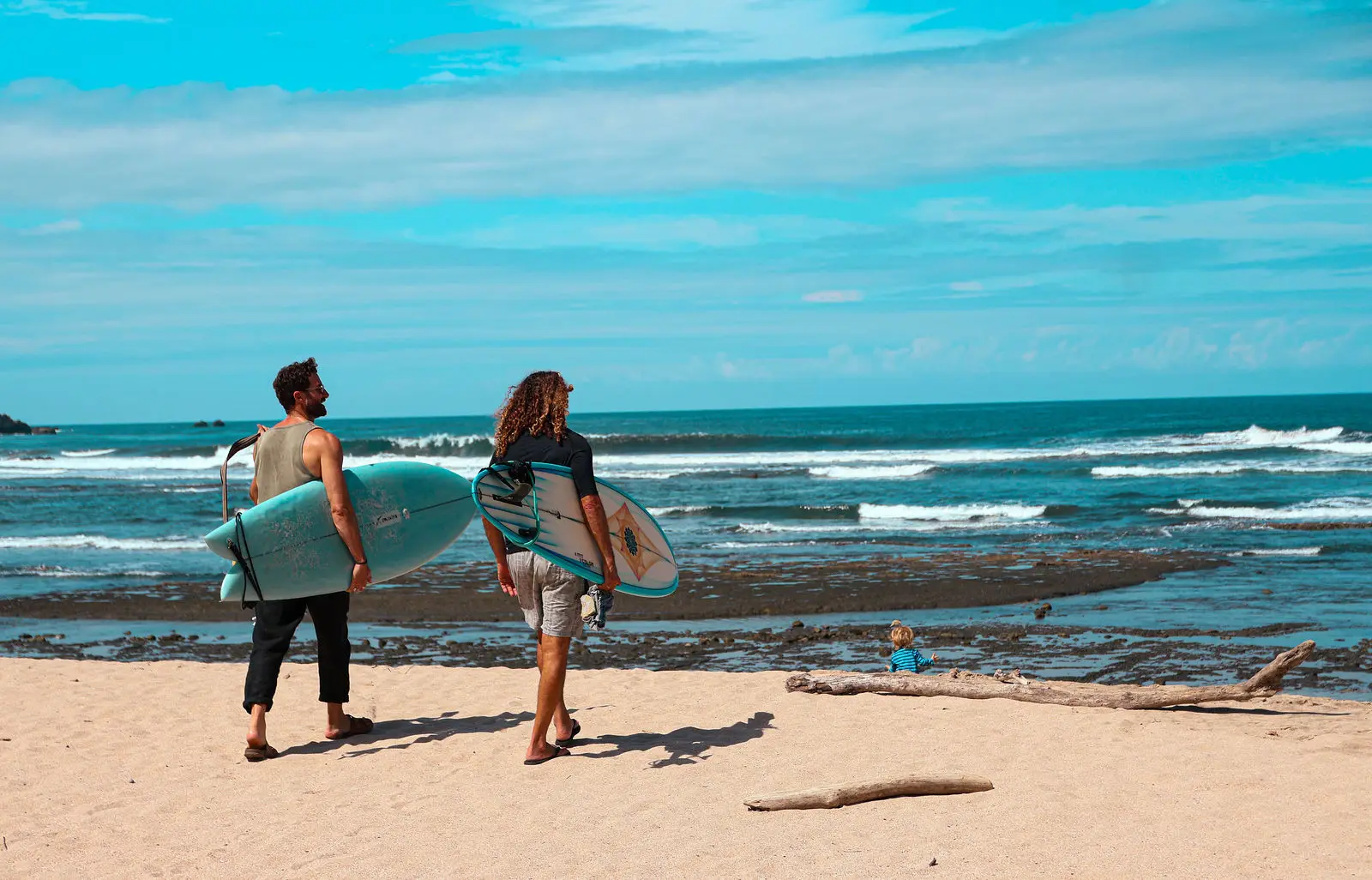
Everything you need to know about Nosara & Costa Rica
Written by a family who has lived here for close to three decades — the things guides leave out and locals simply know.
56 questions answered
What people get wrong
The things we find ourselves explaining again and again. Worth five minutes before you come.
What do people arrive having got completely wrong about Nosara?
That it's a tourist town. It isn't.
There is a big, settled community here. Costa Rican families and long-term expats. Over decades they built a real scene around family, yoga, surfing and wellness. Visitors are guests in that, not the point of it.
The practical upshot is good news: there are events happening across Nosara and the surrounding area all the time, and they're open to you. If you want more than a beach and a pool, that community is the thing worth finding.
Link to this answerWhat do people misjudge about distances and timing?
Everything takes longer here, and that is not a failure of planning — it's the place.
Driving times are longer than the map suggests because the roads are rough. Everything else moves at its own pace too. Letting go of tight expectations around timing isn't a compromise you make; it's most of the magic of being here. The phrase pura vida is doing real work.
If you have scheduled your days here to the half-hour, you have planned the wrong holiday.
Link to this answerWhat do visitors over-pack, and what do they always need and never bring?
Leave behind: fancy clothes, and any shoe that isn't a flip-flop, a hiking boot or a trainer. Heels do not work on this terrain — not as a style opinion, as a physics one.
Bring more of: comfortable clothing. Clothes for yoga and clothes for the beach cover almost every hour you'll spend here. A hat is a very good idea.
If you're Costa Rican, or driving in from elsewhere in the country, throwing beach chairs in the car is a smart move.
- Flip-flops, plus trainers or hiking boots for the trails
- A hat, and more sun protection than you think
- Comfortable clothes — yoga and beach covers most of it
- A reusable water bottle (filtered water is free on the bar at Naya)
- Insect repellent if you're coming in the rainier months
Where do tourists most often get overcharged?
Yes — money, and it's easily avoided.
US dollars are accepted in a lot of places, so people assume they don't need local currency. But if you pay in dollars you will get a poor conversion rate, every time. And if you don't have colones in small denominations, smaller vendors often simply won't have change for you.
Get colones. Withdraw from an ATM rather than changing money, and keep small notes for the Tuesday market and smaller businesses.
Link to this answerDoes Uber work in Nosara?
No. Uber does not operate here. It works in San José and some of the bigger towns, but not in Nosara — do not plan your week around it.
What people actually use:
- Local taxis and tuk-tuks. Agree the price before you get in — fares here are negotiated, not metered.
- A pre-booked shuttle for the airport run, arranged in advance rather than found on the day.
- Walking. Pelada and Guiones are both walkable, and most of what you want is inside them.
- A rental car, if you are going beyond the two beaches or coming in the rainy months.
Staying at Naya, ask us. Marguerite arranges transfers directly and we know which drivers are reliable, which saves you the guesswork.
Link to this answerShould I rent a car at the airport?
Often, no — and this is the single most useful piece of arrival advice we give.
It's 2.5 hours from Liberia (LIR) to Nosara, and at least 6 hours from San José (SJO). Doing that drive yourself, on unfamiliar rough roads, straight off an international flight, is exhausting and is the worst possible introduction to the country.
Consider taking a taxi or a transfer to Nosara instead, and renting a car here once you've slept. When you leave, you can drop the car at an agency next to the airport.
If you're staying at Naya, Marguerite arranges transfers directly — you'll be met by our driver Geovanni.
Link to this answerGetting here
Which airport should I fly into — Liberia or San José?
It depends entirely on what you want from the trip.
Liberia (LIR) is 2.5 hours from Nosara. It is a small international airport and on a calm day getting through it is very easy going. Choose LIR if you're focused on Guanacaste — or on Nosara in particular. That's not a narrow choice: it's a huge area, and the feel changes a lot as you move along the coast and inland, with places like the Arenal hot springs within reach.
San José (SJO) is at least 6 hours away, and it's a much bigger international airport. Choose SJO if you want to see more of Costa Rica on the same trip — the Central Valley, the wildlife parks, the hot springs, the Caribbean coast.
Most guests coming primarily to Naya fly into Liberia.
Link to this answerHow long is the drive really, door to door?
From Liberia, 2.5 hours. From San José, six hours at minimum.
Those are real figures, not optimistic ones — but they assume daylight and dry roads. Add time in the rainy season, and add more if you're driving them for the first time.
Our honest advice: take a cab or a transfer to Nosara and rent a car here instead. The drive in is exhausting after a long flight.
Link to this answerDo I need a 4x4 to reach Naya?
Usually not. Most of the year, any car will make it — including lower sedans.
The exception is the height of the rainy season, September to November, when you want something higher like an SUV to reach us comfortably.
In every month and every vehicle, the real requirement is the same: drive slowly and carefully. The roads punish speed far more than they punish small cars.
Link to this answerCan I rent a quad, a scooter or a bike?
Yes, though not from us — we don't rent them. There are several rental companies around Nosara doing quads and ATVs, scooters and motorbikes, and bicycles and e-bikes.
The useful part: most of them deliver to your hotel and collect afterwards, so you do not need a car in order to go and pick one up. Helmets and insurance are normally included. Ask us and we'll point you at one.
Two things to read first. A quad in the dry months means dust — see the weather question. And the night driving question matters more to you on open wheels than it does in a car.
Link to this answerWhat about driving at night, or after rain?
Be careful — always. Roads after rain need to be taken slowly and navigated carefully.
Night driving around Nosara means unlit dirt roads, no pavements, animals standing on them, and the occasional pothole you won't see until you are in it. If you can arrange to do an unfamiliar drive in daylight, do.
Link to this answerSafety
The honest version. None of this should put you off — it's what locals simply know.
What are the real safety rules here that visitors don't know?
Common sense, applied consistently. Two specifics matter most.
Don't leave valuables in a parked car. And don't wander on beaches or unlit paths alone after dark.
Naya itself is safe. The property is staffed around the clock. But there have been many reports of theft on the beaches, particularly at Playa Guiones. Be alert, and just don't bring valuables to the beach unless someone is going to sit with them the whole time.
Playa Pelada, the beach five minutes from Naya, is safer than Guiones.
Link to this answerCan I leave my things on the beach while I swim?
We wouldn't recommend it, anywhere — unless someone is staying with them.
Playa Pelada sees fewer incidents than Guiones, but the advice holds on both. Take what you need and leave the rest in your room.
Link to this answerIs there anywhere you'd tell someone not to go after dark?
Walking dark streets alone isn't the best idea here, and that goes double for the paths down to the beaches and the jungle trails around Nosara.
These are unlit, and often empty. It is not that something will happen — it's that nobody would know if it did.
Link to this answerWhat should I know about the ocean — currents, rips, times of day?
This is a surfing coast with a strong swell, and that means the water demands respect even if you're only swimming.
There are flags on the beach indicating the safety level — read them. Beyond that, watch the ocean before you get in, every time. Conditions change daily, and the size of the swell is the thing to judge.
Generally, high tide is the best time for swimming and enjoying the water.
At Playa Pelada, low tide is its own attraction: tide pools form that are wonderful to float in, and lovely for children.
Link to this answerAre there animals I should be careful of — snakes, crocodiles, anything in the water?
There are crocodiles in the river, but they are not abundant here — seeing one is a treat rather than a threat. Stay well away, as you would anywhere, and you will never have a problem.
On land, the wildlife section below covers what actually lives around Naya. Howler monkeys, pizotes, iguanas, armadillos. It also covers the sensible precautions for snakes and scorpions.
In the ocean, the one worth knowing about is stingrays. They rest half-buried in the sand in the shallows, and they sting defensively when stepped on. It is not common. It is very painful when it happens, and it is almost entirely preventable — see the next question.
Link to this answerHow do I avoid a stingray sting — and what do I do if it happens?
Preventing it: do the stingray shuffle. Instead of lifting your feet and walking into the water, slide and shuffle them along the sand. The vibration tells a resting ray you're coming and it swims off. Stings happen when a foot lands on top of a ray that never knew you were there. Shuffle every time you walk in, at Pelada and at Guiones. It costs you nothing and removes almost all of the risk.
If someone is stung, it is intensely painful but very rarely dangerous. What matters is acting quickly:
- Get out of the water and sit down — the pain can cause faintness.
- Wash the wound immediately with clean water. Puncture wounds like this carry a high infection risk, and this step matters as much as the pain relief.
- Soak it in hot water — this is the real treatment. Stingray venom is broken down by heat, and hot water immersion is the standard first aid. Use water as hot as can be tolerated without scalding (around 45°C / 113°F), and keep the wound submerged for 30 to 90 minutes, topping up as it cools.
- Test the water on an uninjured hand or foot first. A stung limb loses feeling. The person cannot judge the heat themselves. That is how people end up with a burn on top of a sting.
- Do not dig out an embedded spine. If a barb or fragment is still in the wound, leave it and get medical help.
- Then see a doctor — for wound cleaning, a check for retained fragments, and a tetanus booster if yours isn't current. The medical care question below lists the clinics in Nosara.
When is a sting or bite an emergency?
Get medical help immediately — don't wait it out — if any of these apply:
- A spine or barb is still embedded in the wound
- The puncture is deep, or bleeding heavily
- The wound is to the chest, abdomen or neck
- The person feels faint, nauseous or short of breath, or their heartbeat feels irregular
- Swelling spreads, or the wound looks infected over the following days
In Nosara that means driving to one of the private medical centers, not waiting for an ambulance — see the emergency question below for why.
Link to this answerHow bad are the mosquitoes, and when?
Less bad than you'd expect. Nosara sits in dry tropical forest. It is a rare ecosystem, and far drier than the rainforest most people picture when they think of Costa Rica.
They follow the rain. They are worst from September to November, and there are more of them from May to August too. In the dry season, December to April, they aren't much of a problem.
Dawn and dusk are their hours. The simplest protection is to keep your room's screen door closed, especially around sunset.
On repellent: the ones that work are the EPA-registered ingredients. DEET, picaridin, IR3535, oil of lemon eucalyptus (OLE), PMD or 2-undecanone. Read the back of the bottle for one of those names rather than trusting the front. Oil of lemon eucalyptus and PMD should not be used on children under three.
If you are here in the wet months and spending real time outside, permethrin on your clothes lasts through several washes. It goes on fabric, never on skin.
Link to this answerWhat do people underestimate about the sun here?
How completely it dictates the shape of a good day.
There's a reason the siesta comes from the tropics. Being out at full power in the middle of the day is not advisable, and everyone who lives here knows it. The rhythm that works: get out early. The day starts early here. Then spend the hottest hours, roughly noon to 4pm, by the pool or in your room.
Then the evening, which is the real gift of this coast. This is sunset country, and the beaches fill for it. Go and watch one while you're here.
Go and stand on the beach for it. Don't watch it through a window. Evening light helps set your body clock. It is one reason people sleep unusually well here. Especially after a long flight from another time zone. And there is something about standing still in front of something vast at the end of the day that does more for you than the same half hour spent anywhere else.
At Playa Pelada the whole neighborhood turns out for it. That, more than the view, is the thing to experience.
Link to this answerHealth and emergencies
The essentials. For the full, maintained directory, use nosara911.com — a community-run resource for exactly this.
Who do I call in an emergency?
911 works in Costa Rica, from any phone, and reaches medical, police or fire services.
One thing locals know and visitors don't: an ambulance here has to take you to the public hospital in Nicoya. That is the law. It cannot take you to the private clinics in Nosara. Nicoya is around 1.5 hours away, and the ambulance itself is dispatched from there.
So if the situation is serious but stable, driving yourself to one of the private medical centers in Nosara is frequently faster than waiting for an ambulance. That single fact is worth knowing before you need it.
Even when you take yourself, it's still worth calling 911 — it creates an official record, which local organizations use to argue for better emergency resources here.
For the complete and maintained list of numbers — clinics, pharmacies, dentists, vets, police, fire — use nosara911.com. We deliberately don't reproduce it here, because a phone number that's gone stale is worse than no number at all.
Link to this answerDo I need vaccinations for Costa Rica? Is there malaria?
No vaccinations are required to enter Costa Rica from the US, Canada, the UK or Europe. The one exception is yellow fever, and only if you are arriving from a country where yellow fever is present — flying in from home, it does not apply to you.
There is no malaria in Nosara. Costa Rica's malaria risk sits in Alajuela and Limón provinces, on the other side of the country. Nosara is in Guanacaste. You do not need malaria tablets to come here.
What is here is mosquito-borne illness of a different kind — dengue and chikungunya both circulate in Guanacaste, and neither has a vaccine you can just go and get. The protection is not getting bitten, which is the same advice either way. See the mosquito question above.
Check the CDC's Costa Rica page before you travel for whatever is current. We deliberately do not print the status here, because an outbreak notice that has since been lifted is worse than no information at all.
Link to this answerWhere's the nearest doctor or clinic?
There are two private medical centers in Nosara that handle urgent care and are contactable around the clock, plus the public EBAIS clinic which keeps set hours. There are also doctors who do home visits — which, if you're unwell in your room, is often the easiest option of all.
Full details, current numbers and opening hours are all at nosara911.com. The nearest hospital is in Nicoya, roughly 1.5 hours away.
If you're staying with us and something goes wrong, tell us. We are here to make sure you get the care you need. That means we help you get to the right place — not hand you a phone number and wish you luck.
Link to this answerDo I need travel insurance?
We think it's a good idea, and we'd rather explain why than just say so — because the reasons here are specific, and they aren't obvious from a brochure.
If something serious happens, you are a long way from a major hospital. An ambulance is legally required to take you to the public hospital in Nicoya, about an hour and a half away. The private clinics in Nosara are good and they handle a great deal, but they are private — you pay. For anything serious, medical evacuation out of Nosara is a real thing people here occasionally need. nosara911.com has a whole guide on how to request one.
None of that is frightening in normal circumstances. It simply means that a problem which would be an inconvenience at home can become complicated, and expensive, here.
Most visitors arrange cover at home before they travel, and it is usually inexpensive relative to the trip. We don't recommend a specific company — policies and terms change, and it isn't our place to sell you one. Arrange it before you fly, and check that it covers medical evacuation and any adventure activities you're planning, since surfing is sometimes excluded.
Link to this answerThe beaches and surfing
How far are the beaches from Naya?
Playa Pelada is a five-minute walk through the jungle. That's the beach at Naya's doorstep.
Playa Guiones is 30 minutes on foot along the beach, or about 20 minutes by car.
- Playa Pelada — 5 minutes on foot
- Playa Guiones — 30 minutes walking along the beach, 20 minutes by car
I've never surfed. Where do I start?
Guiones, not Pelada. Pelada is not a surfing beach; Guiones is, and it's good for beginners.
Don't just rent a board and paddle out. Get a guide — someone to show you where the waves are working, sort your board, and introduce you to how the line-up works here. That last part matters more than people realize, and it's covered in the etiquette question below.
We connect our guests with excellent local teachers. Ask us and we'll sort it.
Link to this answerWhere can I rent a board?
Selva, and plenty of other surf shops around Nosara. Guiones is the beach you'll want it for.
Link to this answerIs there a best time of day to surf?
It depends on the tide, and the tide changes every day — high tide is generally the one you want.
Ask that morning. Anyone in a surf shop at Guiones will tell you what the day is doing.
Link to this answerThe turtles at Ostional
One of the great wildlife events on earth, half an hour up the coast.
When should I come to see the turtles — and can you predict it?
August through December. September, October and November are the big ones, when more than 100,000 turtles can come ashore in a single night. Arribadas happen the rest of the year too, roughly January to July, but they are much smaller — usually under 20,000 turtles across three or four nights.
Now the useful part, the part most people don't know: arribadas follow the moon. They cluster around the last quarter moon. They tend to start on the dark nights running up to the new moon. The cycle repeats roughly every 28 days, which is why an arribada at Ostional is usually a once-a-month event lasting three to five nights.
So if you are planning a trip around seeing this, look at a lunar calendar and aim for the days just after the last quarter moon, in September, October or November. That is as close to a prediction as exists.
But it is a prediction, not a timetable. After decades of monitoring, nobody fully knows what sets an arribada off. Wind, the salt in the sand, currents and sea height all seem to play a part alongside the moon. It is a wild event, not a show, and some nights it simply doesn't come.
Which is the practical argument for staying nearby rather than making a special trip: from Naya you are half an hour away, so you can go when it actually starts. The guides' association in Ostional posts when an arribada begins — that is the only reliable signal there is.
Link to this answerDo I need a guide?
Yes, and this isn't a formality — you are not allowed on the beach without one.
We're connected to the local turtle protection association and recommend their guided tours. That is the safe and legal way to see the turtles, and the money stays with the people protecting them.
The refuge is the Refugio Nacional de Vida Silvestre Ostional. It is run in partnership with ADIO, the community organization in Ostional. If you arrive independently, guides can be hired at the guides' association office in the village, next to the football pitch. They also post updates when an arribada begins and how long they expect it to last, which is the only reliable way to know.
Link to this answerIs it true they harvest the turtle eggs? Isn't that illegal?
It's true, and Ostional is the only beach in the world where it is legal. It surprises everyone who hears it, and the reasoning is sound.
During an arribada so many turtles come ashore at once that they dig up each other's nests. Most of the eggs laid in the first wave get dug up by the turtles nesting after them. And that many eggs packed into the sand spoils the ones left behind.
So since 1987, the community at Ostional has been allowed to harvest a small share of the eggs from the first days of an arribada. The ones least likely to survive anyway. It is run by ADIO, the community association, authorized and supervised by MINAE, the environment ministry.
The effect is that the village has a legitimate livelihood tied directly to the turtles surviving, rather than a black market working against them. It is one of the more unusual conservation arrangements anywhere, and it is why the beach is patrolled and protected as carefully as it is.
Link to this answerWhat should I understand before I turn up?
Be peaceful, and be respectful.
You are watching an animal do the single most vulnerable thing it does, on the beach at Ostional, where they have done it for longer than there have been people to watch. Lights, noise and crowding harm the nesting. Follow your guide exactly.
Link to this answerHow do I get to Ostional from Naya?
By taxi or in your own car. We can help you arrange it.
Link to this answerWildlife and nature
What will I see just by being at Naya?
Without going anywhere: pizotes (coatis), iguanas, howler monkeys, raccoons, skunks, and birds of every description.
The howler monkeys are the ones that surprise people — they are loud, they are often overhead, and dawn is their hour. The canopy was deliberately preserved when Naya was built precisely so they still have a route through.
The birdlife is the part people underestimate. This is dry tropical forest, which has its own cast rather than the rainforest species most visitors picture. Look for the turquoise-browed motmot — brilliantly colored, with two long tail feathers ending in bare rackets, and the signature bird of this region. The white-throated magpie-jay is the loud, crested, impossible-to-miss one. Black-headed trogons sit very still in the mid-canopy. Orange-fronted parakeets and yellow-naped parrots move in noisy flocks, usually heard before seen.
Early morning is when all of this happens. If you want to see it properly, the reserve next door is the place — see the walks question below.
Link to this answerWhich animals will I actually share the place with — and what do I need to know?
This is a jungle, and the animals here are not visiting your holiday — you are visiting their habitat. Almost none of it is dangerous. Some of it is worth knowing in advance, which is why we'd rather tell you now than have you find out at 6am.
- Howler monkeys — constantly on the move through the canopy, and they pass through Naya regularly. You will hear them coming long before you see them; they are astonishingly loud for their size, and dawn is their hour. The old-growth trees here were deliberately kept so they still have a route through. Nothing to do except enjoy them.
- Pizotes (coatis) — related to raccoons, with a long white snout and an upright tail, and they travel in noisy bands that can be twenty-strong. They are clever, bold, and they steal food. The rule is simple: never leave food outside, and keep your door closed. A pizote that learns a room is a food source will come back.
- Iguanas — everywhere, harmless, and better looking than photographs suggest. They like to sit in the sun and be admired.
- Armadillos — prehistoric-looking, mostly out at dusk and through the night, snuffling through the leaf litter. They are very nearly blind and navigate almost entirely by smell, which is why one will occasionally trundle right past your feet without registering you at all.
- Snakes — yes, there are snakes. They are far more afraid of you than the reverse and they keep their distance. The one genuine precaution: carry a torch when you walk at night, and look where you're putting your feet.
- Scorpions — also present, as they are throughout this region. They hide in dark, enclosed places. Don't put your hand somewhere you can't see, and shake out clothing or shoes that have been left accessible. If you keep your room closed up they don't get in.
When's the best time to see wildlife?
Early morning and late afternoon — the same hours that are most pleasant to be outside anyway.
Through the year the birds migrate in and out, so the Guanacaste birdlife changes with the season. The land animals — howler monkeys, pizotes, iguanas — live here alongside us all year round.
Link to this answerAre there walks or nature spots nearby?
Naya sits right next to the Reserva Biológica Nosara, the private reserve behind Lagarta Lodge — a river mouth, a river, and a mangrove forest. It is magnificent, and it is on your doorstep.
It is around 35 hectares, with marked trails running down through the mangrove wetland to the river and the beach. Walking it takes roughly two hours. Pick up a map and walk it yourself, or join a guided walk with a biologist. Those run early morning or mid-afternoon. Those are also the hours the animals are moving.
People regularly see howler monkeys, coatis, anteaters, raccoons, iguanas, and a great deal of birdlife. Boat trips on the Río Nosara and Río Montaña are also run from there, through the mangroves, where crocodiles are a real possibility.
There is an entrance fee, and a higher price if you want the guided walk; both are modest. Rates and tour times change, so check with the lodge or ask us and we'll find out for you. (Checked September 2026.)
Link to this answerEating and shopping in Nosara
Where we would actually send a friend.
Where would you send a friend to eat?
Our own list, not a directory:
- Sunrise Cafe — breakfast and lunch, in Pelada.
- Olo Alaia — a surf shop and café
- Harmony Hotel juice bar — a midday break while you're at Playa Guiones
- La Luna — on the beach at Pelada, and great for sunset
- Coyol — up on a mountain, the best sunset views anywhere here
- El Chivo — burgers and a bar, in Pelada
Somewhere for a special evening?
Four places, each for a different kind of evening:
- La Luna — right on the beach at Playa Pelada, ten minutes from Naya. The sunset one, and the one to book.
- Coyol — up on a mountain, with the best sunset views anywhere around here. Go for the view as much as the food.
- Tierra Magnifica — the smart, special-occasion option.
- Muazzzi — a Jerusalem-inspired Middle Eastern restaurant near Playa Guiones, run by chef Muaz Monsour, who came to Nosara from Michelin-starred kitchens. A hummus bar, charcoal shawarma and arayes, house-made amba and zhoug. Not what you expect to find in a small surf town. Dinner only, Wednesday to Saturday — check before you go.
Where do I buy food?
The most significant one, and where you'll see everyone buying their groceries, is the Tuesday market. If your stay includes a Tuesday, go — and take small notes in colones, because not every stallholder takes cards.
Otherwise:
- La Tienda — organic produce, Playa Pelada
- Tony's — organic meat, Playa Pelada
- Super Nosara — general groceries
- La Bodega — a smarter convenience store in Pelada
- Orgánico — the most high-end organic supermarket
- Rinde Más — a big supermarket, known for low prices
What should I order that I wouldn't think to?
Two things, and one of them has a lovely name.
Gallo pinto is the traditional Costa Rican breakfast — rice and beans cooked together, usually with eggs. The name literally means "spotted rooster", because cooking the rice with the beans stains it, and the speckled result looks like a rooster's plumage. It is what the country actually eats in the morning, and it is what we cook if you order breakfast at Naya.
The distinction worth knowing: in a casado — the classic Costa Rican lunch plate — the rice arrives white, with the beans served alongside. Same two ingredients, cooked apart rather than together. Gallo pinto is breakfast; casado is lunch. Order accordingly and you'll sound like you've been here before.
Pipa is the other one. A young green coconut, cut open in front of you, drunk cold through a straw. You'll see them sold from roadside stands and coolers everywhere. On a hot afternoon here it beats anything you could buy in a bottle.
Link to this answerMoney and practical things
Is there an ATM in town that reliably works?
Yes, all of them. BCR, Lafise and BAC, plus others over in Guiones.
Withdrawing colones from an ATM gives you a far better rate than paying in dollars or changing cash.
Link to this answerShould I bring cash, and how much?
Bring a small amount as a backup, and withdraw colones at the airport when you land — enough for emergencies and for the vendors who don't take cards.
Most places take cards these days. The clearest exception is the stallholders at the Tuesday market.
The thing that actually catches people out isn't having too little cash — it's having only large notes. Small denominations matter here.
Link to this answerWhat surprises people when they arrive?
How beautiful Nosara is, and how slow. It is a shock to most Western systems.
That shock is usually the best thing that happens to people here, but it takes a couple of days. Plan for it rather than fighting it.
Link to this answerCulture and etiquette
Is there anything visitors do that's unintentionally rude?
Being uptight and demanding doesn't win you friends anywhere, and particularly not here. That's the general answer.
The specific one is in the water at Guiones. Learn the surfing rules before you paddle out, and don't put yourself in the line-up before you're ready to be there. Dropping in on someone, or being somewhere your ability doesn't justify, isn't just rude — it endangers other surfers. This is the one piece of local etiquette visitors most often get wrong.
Link to this answerHow does tipping actually work?
It isn't required, but it's always kind and always appreciated.
Restaurants in Costa Rica typically include a service charge already, so anything you add is extra rather than expected.
Link to this answerWhat Spanish is genuinely useful?
You do not need Spanish to have a good time here — but a little goes a long way, and Costa Ricans are generous about it.
The two that will actually change your day:
- Pura vida — literally "pure life". It is hello, goodbye, thank you, no worries, I'm well, and it's all good, depending entirely on how you say it. It is not a slogan for tourists; people use it constantly.
- Con gusto — "with pleasure". This is what Costa Ricans say instead of "de nada" when you thank them. Using it marks you out as someone who has actually been paying attention.
- Gracias — thank you. Muchas gracias for more of it.
- Buenas — the all-purpose greeting, shortened from buenos días / buenas tardes. Works at any hour, in any shop.
- Por favor — please.
- ¿Cuánto cuesta? — how much is it?
- La cuenta, por favor — the bill, please.
- Mae — roughly "mate" or "dude". You will hear it endlessly between Costa Ricans. Best enjoyed rather than attempted.
Is there any nightlife?
Not in the way you would mean it in a city. There is no strip of clubs, and most of Nosara is asleep early because most of Nosara is up early.
What there is instead are events. In high season there is something on most weeks — music, a party, a DJ night at one of the hotels or restaurants — and you hear about them constantly once you are here. They are not advertised in advance in a way you could plan a trip around.
So the answer is: turn up, ask, and you will know within a day. Naya itself hosts events with live music and DJs — see our events and food page.
Link to this answerAnything about local life I should understand?
Nosara runs on health, movement, connection and nature. In one form or another, most of what is here speaks to that.
Feel into it, and enjoy it.
Link to this answerThe year in Nosara
What's the weather really like — not the brochure version?
Hot. Guanacaste is the hot, dry corner of Costa Rica, and that is the deal.
From December through March the dirt roads around Nosara get seriously dusty. If you're riding a quad in those months, wear a bandana over your mouth and nose — that's not a style tip, it's what people here do.
The dry season runs from the end of November to May.
From May to July there is some rain, and now and then a windy spell brings a storm or two. Then, in July, come about 20 days of "little summer" — dry, sunny weather in the middle of the rains.
In August the rain starts again, little by little. It gets stronger through September and October into November, when the landscape is at its greenest, and it fades as December approaches.
Link to this answerWhich months are quiet, and is that a bad time to come?
September, October, April, May, June and July are the quiet ones.
Nosara is sleepy and beautiful in those months, and still full of local life — people, plants and animals are here all year regardless of visitor numbers. For a lot of travelers these are the better months, not the worse ones.
Link to this answerYoga and wellness nearby
Is there a gym?
Not at Naya. But Nosara takes training seriously for a town this size, and there are three real gyms — not a treadmill in a cupboard.
- Nosara Functional Fitness, in Playa Pelada — the closest one to us, and the most hands-on. Personal training and small group classes built around TRX, kettlebells, clubbells and kickboxing, plus surf-specific training. They also do physiotherapy and bodywork, so it is the one to go to if something hurts rather than just needs working.
- The Gilded Iguana Athletic Center, in Guiones — the most like a proper gym in the way you are used to. Serious machines and free weights, well kept, and non-guests can buy a day pass. Group classes too.
- Bodhi Tree, in Guiones — two gyms on one site. An air-conditioned main gym with cardio and weights, which matters more here than it sounds, and an open-air community gym for lifting outside.
For classes rather than weights — yoga, pilates, movement — see the studios question below.
Link to this answerWhere should I practice while I'm here?
Where we would send you, all of them in Nosara:
- Nalu
- Sendero
- Black Cat Pilates
- Bodhi Tree
Before and after Nosara
Where do people go next?
From Nosara, most commonly Monteverde and Arenal. Sometimes down the coast to Uvita, Dominical or Chirripó.
Link to this answerIf I have two weeks in Costa Rica, how should I spend them?
Marguerite's answer:
- 1 day to arrive at Naya
- 9 days to fully enjoy, explore and rest
- 3 days exploring a different ecosystem and the hot springs at Arenal
- 1 day to return
Is Nosara usually a first stop or a last one?
Some people pass through quickly during the arribada to see the turtles and move on.
But most people who come to Nosara come for the place itself — the scene, the surf, and the chance to take their time. It rewards staying rather than passing through.
Link to this answerQuestions about staying at Naya?
Check-in, the rooms, WiFi, breakfast, accessibility, and how retreats and group bookings actually work.
About Naya →Still haven’t found it?
Ask us anything — Nayanosara@gmail.com or on WhatsApp. A real person answers.